Physical Address
304 North Cardinal St.
Dorchester Center, MA 02124
Physical Address
304 North Cardinal St.
Dorchester Center, MA 02124

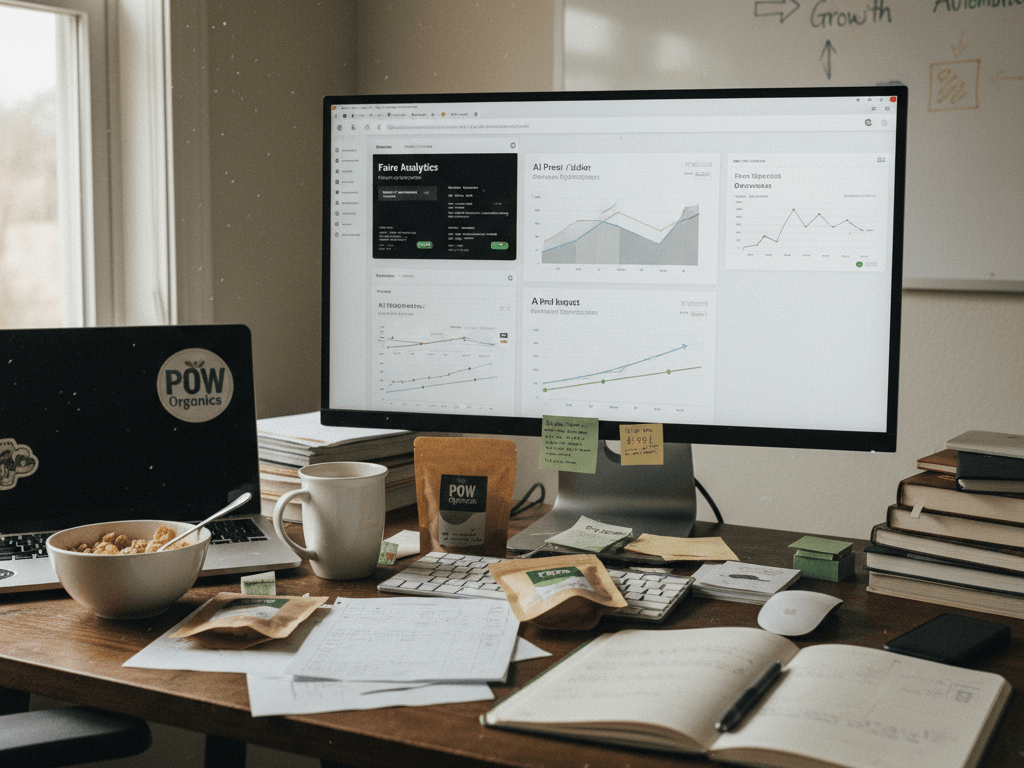
A one-person business usually breaks in the same place: not on product, but on judgment. A solo founder can make the product, ship the orders, answer the emails, and even post the content. The harder part is making dozens of small commercial decisions well, every week, without a team. Which channel deserves attention. Which listing is underperforming. Which photo is weakening conversion. Which opportunity is real and which one is just noise. In a larger company, those decisions get spread across growth, creative, ecommerce, and strategy roles. In a one-person company, they pile up on the founder’s desk.
Ezra Rufino was dealing with exactly that problem at Pow Organics, his functional beverage brand built around products like mushroom matcha and mushroom coffee. The challenge was not only building a brand in a crowded consumer category. It was doing it without the specialist bench that larger CPG companies take for granted. Wholesale marketplace performance, product photography, listing copy, and channel prioritization all matter, but each one can easily become its own mini-discipline. For a solo founder, that usually means tradeoffs: either pay for outside help, or accept that some revenue leaks out through imperfect execution.
Rufino used AI to avoid that tradeoff. By February 3, 2026, he said AI had become a kind of pseudo-cofounder: a system he used not only for execution help, but for pushback and decision discipline. One of the clearest examples was Faire, the wholesale marketplace where emerging brands compete for retailer attention. Rufino asked AI to review his listings and surface low-hanging improvements. It returned rewritten copy, photography suggestions, and other changes he could implement directly. After he put those recommendations in place, Pow Organics posted 305% year-over-year growth on Faire in Q4.
That outcome is useful because it points to a specific AI pattern that works well for solo founders: multimodal merchandising analysis. OpenAI’s current product documentation shows that ChatGPT can analyze uploaded images, screenshots, and files, and can also work with structured data to extract patterns and insights. In practical terms, that means a founder can feed the model marketplace screenshots, product pages, ad dashboards, catalog spreadsheets, or retailer-facing copy and ask for concrete improvements. The model does not replace taste or business judgment, but it does compress the work of first-pass analysis. AI was functioning as an on-demand combination of junior growth operator, merchandising reviewer, and strategic sounding board.
That matters because marketplace performance is often decided by details that are individually small but commercially decisive in aggregate. A wholesale buyer scanning Faire does not experience a brand the way a founder does. The buyer sees thumbnails, packaging clarity, category fit, price logic, copy sharpness, and a sense of whether the product will move in-store. If the photography is weak, the description is vague, or the value proposition is buried, the buyer never reaches the founder’s actual vision. AI helped Rufino close that translation gap.
A realistic example shows the mechanism. Imagine a product listing for a mushroom matcha blend that has decent ingredients, but a cluttered image order and copy that talks more about the founder’s philosophy than the retailer’s resale opportunity. In the old workflow, Rufino would have to diagnose that himself or pay a consultant or freelance growth operator to review it. In the new workflow, the listing becomes the input. AI reviews the screenshot, flags what is visually weak, suggests better sequencing or positioning, rewrites the description around buyer clarity, and gives the founder a sharper version to test. Input: an underperforming wholesale listing. Processing: screenshot analysis, copy revision, positioning feedback, and prioritization. Output: a listing more likely to be discovered, understood, and ordered. The business effect is not abstract productivity. It is improved commercial packaging of the same product.
The strategic layer may be even more important than the copy layer. Rufino described using AI to challenge his excitement about new opportunities and keep him from spending time where the upside was weak. That is a subtle but powerful use case for one-person companies. Solo founders do not just lack labor. They often lack counterweight. In a team, someone can say the partnership is distracting, the channel is too early, or the idea does not justify the effort. Alone, the founder has to generate that resistance internally. AI can help simulate it. Not perfectly, but often well enough to stop bad time allocation before it becomes a bigger problem.
The economics behind the 305% growth number are straightforward. Wholesale marketplaces reward clarity and consistency. If better images, sharper copy, and more disciplined listing structure raise retailer conversion, then a founder can increase sell-through without hiring an agency, a marketplace specialist, or a brand photographer for every round of changes. Even under conservative assumptions, the payback looks attractive. If a founder is spending a few hundred dollars a month on AI tools instead of thousands on piecemeal consulting, one meaningful marketplace lift can cover that cost very quickly. The exact return depends on baseline wholesale volume, but the shape of the economics is obvious: small software cost, potentially large merchandising upside.
The bigger lesson is not that AI magically creates growth. It is that AI gives solo founders access to functional depth they would not normally be able to afford. Pow Organics still needed product-market fit, brand quality, and execution discipline. AI did not invent those. What it did was narrow the capability gap between one founder and a larger consumer brand with dedicated ecommerce, design, and growth staff. That is a more important shift than simple time savings. A one-person company becomes more competitive when it can make better decisions, not just faster ones.
This is why the Pow case matters beyond beverages. Freelancers, indie makers, and solo ecommerce founders all face some version of the same operational bottleneck: too many specialist tasks attached to a small business, and too little budget to hire each specialist well. AI becomes most valuable when it sits at that boundary. It helps the founder review, compare, rewrite, pressure-test, and prioritize before money is spent or momentum is lost. Pow Organics’ Faire result shows what happens when that support is applied to a channel where merchandising quality directly affects revenue. The founder did not stop being solo. He simply stopped making every decision without assistance.