








 Plotly
Plotly provides premium open-source data visualization libraries and low-code framework Dash, enabling data scientists to build interactive, production-ready web applications with Python, R, and Julia.
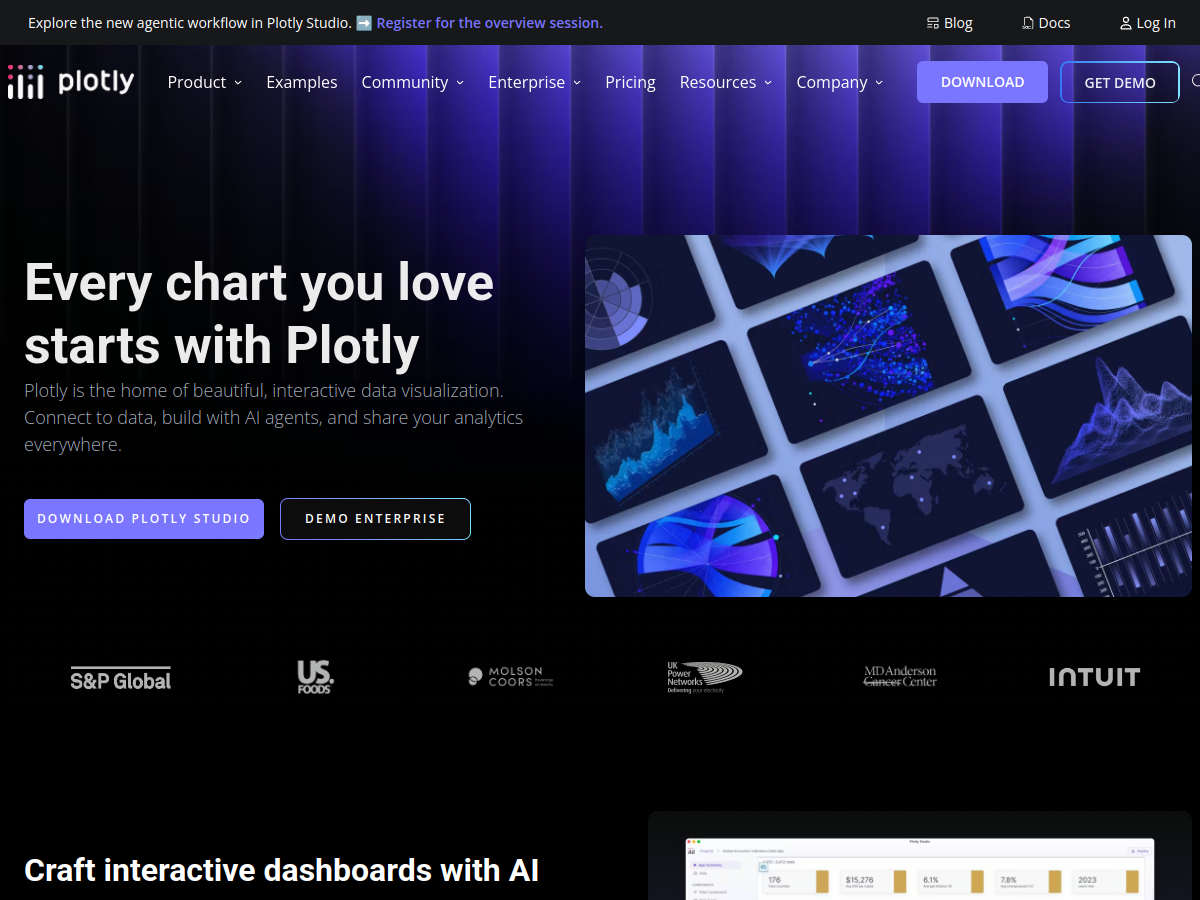
Plotly is a pioneering data visualization company renowned for its open-source graphing libraries and Dash, a powerful framework for building analytical web applications. Widely adopted by data scientists, engineers, and researchers globally, Plotly enables the creation of highly interactive, publication-quality charts directly within Python, R, Julia, and JavaScript environments. Its visualizations span a massive range of types, from basic line and bar charts to complex scientific, 3D, financial, and geospatial plots.
The crown jewel of Plotly's ecosystem is Dash, an open-source Python framework designed for building full-stack web applications without requiring any knowledge of HTML, CSS, or JavaScript. Dash connects interactive Plotly charts with custom user interface components like dropdowns, sliders, and text inputs. This allows data teams to encapsulate complex machine learning models, statistical analyses, and big data pipelines into sleek, interactive enterprise dashboards that business stakeholders can easily manipulate and understand.
Plotly also offers Dash Enterprise, a commercial platform designed to streamline the deployment, scaling, and governance of data apps across large organizations. Dash Enterprise includes advanced capabilities like Kubernetes integration, enterprise-grade authentication, role-based access control, and low-code design tools. By bridging the gap between data science and production-ready software, Plotly helps modern enterprises accelerate their analytics workflows, optimize operational efficiency, and drive data-informed decision-making.





Infogram is an intuitive web-based visualization tool that allows users to create stunning infographics, interactive charts, maps, and professional business reports effortlessly.